

You Help Families Navigate Vulnerable Moments
Look Again is a statewide initiative led by the Kansas Alliance for Drug Endangered Children (KADEC). It supports early identification, stigma-aware engagement, and coordinated response for children affected by substance misuse.
In Kansas, thousands of families are navigating the effects of substance misuse while trying to maintain housing, employment, caregiving, and stability.
You are often the bridge between crisis and recovery.
Children living in homes impacted by substance misuse are more likely to experience housing instability, food insecurity, and educational disruption.
What Is a Drug Endangered Child?
A drug-endangered child (DEC) is a child living in an environment where substance use, misuse, manufacturing, or distribution places their safety, health, or development at risk.
The DEC approach centers child safety and coordinated support. It does not assume criminal intent. It prioritizes stabilization whenever safely possible.
Substance misuse does not define a family’s future. Coordinated support strengthens protective factors and long-term stability.
Why Early Identification Matters in Social Services
What may present as non-compliance, missed appointments, or disengagement may reflect instability rather than unwillingness.
When patterns are recognized early and addressed through coordinated planning, repeat crises are reduced.
Children impacted by caregiver substance misuse may experience:
- Housing instability
- Food insecurity
- Emotional trauma
- Caregiver inconsistency
- Delayed development
Early identification strengthens prevention.
What Look Again Is Asking of Social Service Professionals
You’re not being asked to assume intent.
You are asked to:
- Recognize patterns of risk
- Apply trauma-informed practice
- Document observable concerns
- Follow mandated reporting requirements
- Coordinate with cross-sector partners
Your documentation and referrals activate a broader system of care.
Coordinated, multi-agency response reduces repeat child welfare involvement and improves long-term outcomes.
Trauma-Informed Case Management
Families are more likely to engage when they feel respected and understood.
Helpful practices include:
Using person-first language
Avoiding shaming or stigmatizing terminology
Clearly explaining processes and next steps
Collaboratively developing safety plans
Emphasizing available supports rather than consequences
Predictable communication and collaborative planning reduce escalation and strengthen trust.
Stability is built through consistency.
Kansas Reporting & Referral
Balancing family preservation with child safety can be complex.
Reporting does not assume wrongdoing. It ensures that safety assessments are conducted by the appropriate authority.
When safety is uncertain, reporting allows trained professionals to evaluate risk and determine next steps.
If you suspect a child may be at risk:
- Contact the Kansas Protection Report Center: 1-800-922-5330
- Online reporting is available through the Kansas DCF
- Reports can be made 24 hours a day
If a child is in immediate danger, call 911.
Spanish-language reporting assistance and community resources are available.
The goal is child safety and family stabilization whenever safely possible. Reports may remain confidential.
You don’t need proof. You need reasonable concern.
Coordinated Stabilization Across Kansas
Families rarely experience challenges in isolation. Systems should not operate in isolation either.
KADEC supports Drug Endangered Children alliances in 37 Kansas counties, connecting social services, healthcare, schools, law enforcement, and behavioral health providers.
When agencies coordinate:
- Safety planning becomes consistent
- Duplicative assessments are reduced
- Referrals move more efficiently
- Families experience fewer service gaps
- Repeat crisis involvement declines
Your case notes may become the connective thread that activates coordinated support.
If your county is not connected to a DEC alliance, KADEC can help strengthen collaboration.
Look again. Be the difference.
Downloadable Resources

Know the Signs Printable Tip Card
Download PDF ›

Alcohol Awareness Printable Tip Card
Download PDF ›
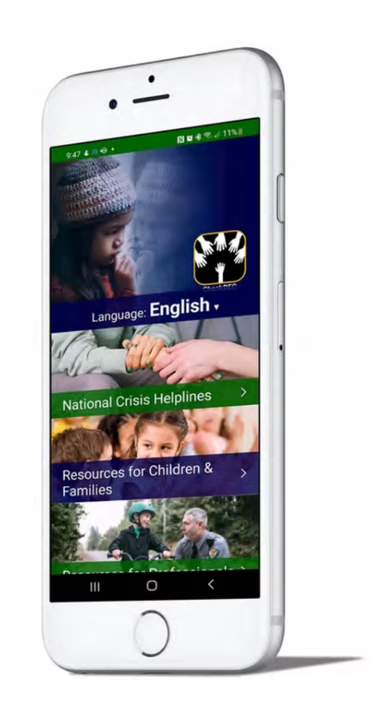


Get the CheckDEC Web App
CheckDEC is a free app from the National Alliance for Drug-Endangered Children that puts local, zip-code–specific substance-use resources, crisis helplines, treatment referrals, videos and real-life stories right in your hand — giving children, families, concerned community members and professionals instant, shareable support when they need it most.
- Direct crisis helpline links and immediate pathways to help.
Resources and downloadable handouts for families and tools for professionals.
Videos, an up-to-date news feed, and peer stories to inform and inspire.
Submit your own story or message of hope; share resources with others.
Free and available now on iOS, Android. Download using the QR code or button, and for more information visit www.checkdec.org.
FAQs
How do I balance family preservation with child safety?
Child safety is always the priority. Coordinated intervention supports stabilization while protecting children whenever safely possible.
When should I involve a DEC alliance?
When families experience cross-system needs, repeated crisis involvement, or gaps in coordination. DEC alliances strengthen communication across agencies.
Coordinated response reduces repeat crises and strengthens long-term stability
Does reporting mean removal from the home?
Not automatically. Reporting triggers assessment. The primary goal is safety and stabilization whenever safely possible.
How can trauma-informed practice reduce re-traumatization?
Clear communication, predictable processes, collaborative planning, and respectful language increase engagement and reduce escalation.
How does coordinated response reduce repeat involvement?
When agencies communicate early, families experience fewer duplicative services and more consistent support.
Have additional questions?
Contact KADEC to connect with alliance leaders, cross-system coordination support, or training opportunities.
Coordinated care reduces repeat crisis
You don’t have to solve this alone. Kansas has a coordinated system designed to support children and families. Your role is to notice and respond.
The Kansas Alliance for Drug Endangered Children is a statewide multidisciplinary network formed in 2003 to improve outcomes for children impacted by substance misuse through training, collaboration, and coordinated response.