

You May Be the First to Notice Silent Harm
Look Again is a statewide initiative led by the Kansas Alliance for Drug Endangered Children (KADEC). It supports early identification, stigma-aware engagement, and coordinated response for children affected by substance misuse.
In Kansas, nearly 140,000 children live in households where substance misuse may impact safety and stability. An estimated 5,000+ infants are born exposed to substances each year.
Healthcare professionals are uniquely positioned to recognize early indicators and connect families to support before crises escalate.
Early identification in healthcare settings can interrupt long-term harm.
What Is a Drug Endangered Child?
A drug-endangered child (DEC) is a child who lives in an environment where substance use, misuse, manufacturing, or distribution places their safety, health, or development at risk.
The concern is not the legality of a substance. The concern is impact on supervision, safety, and developmental stability.
Substance use disorder is a treatable health condition. Early recognition and coordinated support improve long-term outcomes.
Why Early Identification Matters in Clinical Settings
Clinical encounters often reveal patterns others may not see.
Prenatal visits, well-child exams, emergency department visits, and behavioral health appointments all provide opportunities for early support.
Children exposed to caregiver substance misuse are at increased risk for:
- Developmental delays
- Behavioral health challenges
- Adverse Childhood Experiences (ACEs)
- Chronic disease
- Repeated emergency care utilization
Small clinical observations can change a child’s trajectory.
What We Mean by Early Assessment
Addressing substance use concerns in a healthcare setting does not mean labeling or diagnosing a caregiver.
It often begins with something much simpler and may look like:
- Noticing patterns or environmental risk factors
- Asking structured, non-judgmental questions
- Using brief, validated tools when appropriate
- Connecting families to additional support if needed
These conversations can happen during well-child visits, prenatal appointments, emergency care encounters, or behavioral health visits.
Often, it is not one single moment that signals concern, but a pattern observed over time.
Approaching these conversations with curiosity rather than assumption helps preserve trust while protecting children.
Early assessment is an extension of preventive care. It’s about noticing risk and responding thoughtfully, and most importantly, not assigning blame.
National Resources for Screening and Clinical Guidance
These tools and reference guides support routine screening, brief intervention, and referral pathways in clinical settings.
NIH/NIDA Screening Tools
Validated tools for identifying substance use and related risk factors in clinical environments.
SBIRT Framework (SAMHSA)
Guidance for integrating Screening, Brief Intervention, and Referral to Treatment into routine care workflows.
SAMHSA Clinical Guidance: Substance Use Treatment and Child Safety
Best practices for working with families where child safety considerations may intersect with treatment.
Referral & Community Support Resources | Kansas & National
When additional support is needed, these directories connect families to treatment, prevention, and stabilization services.
Kansas Department of Health and Environment (KDHE) SUD & Prevention Resources
Statewide substance use treatment and prevention services.
FindTreatment.gov | SAMHSA Treatment Locator
Searchable national directory of substance use treatment providers by zip code.
Kansas Children’s Service League
Family support, prevention services, and child abuse prevention programs.
Prevention and early referral reduce repeat emergency utilization and strengthen long-term family stability.
Clinical Indicators That May Signal Risk
Indicators requiring clinical judgment and documentation may include:
- Prenatal substance exposure
- Developmental delays
- Failure to thrive
- Repeated injury
- Missed follow-up appointments
- Caregiver impairment during visits
- Unsafe medication storage
These signs do not confirm substance misuse. They signal the need for thoughtful assessment and documentation.
Trauma-Informed Clinical Conversations
It can feel difficult to address substance use concerns in a clinical setting.
Helpful practices include:
- Use person-first language
- Avoid an accusatory tone
- Focus on child safety and support
- Normalize help-seeking
- Emphasize available resources
Example approach:
“I want to make sure your child has all the support they need. Let’s talk about what might help.”
When families feel respected, engagement increases.
Kansas Reporting and Referral
It can feel uncomfortable to report concerns involving a caregiver. Reporting is not an accusation. It is a step toward assessing safety and connecting families to support when needed.
If your clinical judgment raises reasonable concern:
- Follow institutional protocol.
- Contact the Kansas Protection Report Center: 1-800-922-5330
- Online Reporting is available through the Kansas DCF
- Reports can be made 24 hours a day
- Spanish-language reporting assistance is available
If a child is in immediate danger, call 911.
You do not need proof. You need reasonable concern. Reports may remain confidential.
Coordinated Clinical Response Across Kansas
Healthcare providers are often the first to recognize patterns across time.
KADEC supports Drug Endangered Children alliances in 37 Kansas counties, connecting healthcare providers with schools, child welfare, behavioral health, law enforcement, and social services.
When agencies communicate early:
- Referrals are more efficient
- Families experience fewer gaps in care
- Repeat emergency visits decline
- Safety planning becomes clearer
Clinical documentation can activate coordinated follow-up beyond the clinic walls.
If your hospital, clinic, or practice is not connected to a local DEC alliance, KADEC can help facilitate collaboration.
Look again. Be the difference.
Downloadable Resources

Know the Signs Printable Tip Card
Download PDF ›
Alcohol Awareness Printable Tip Card
Download PDF ›
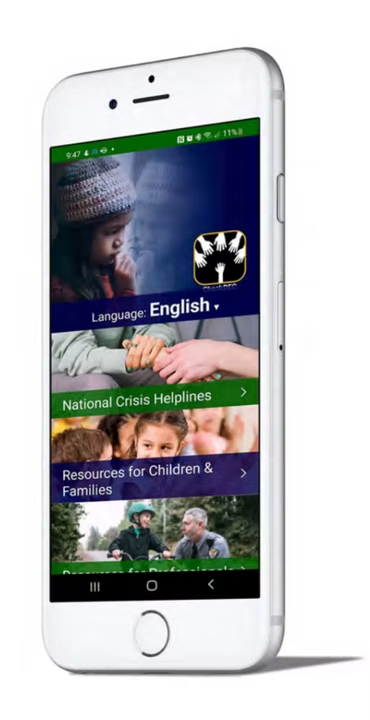


Get the CheckDEC Web App
CheckDEC is a free app from the National Alliance for Drug-Endangered Children that puts local, zip-code–specific substance-use resources, crisis helplines, treatment referrals, videos and real-life stories right in your hand — giving children, families, concerned community members and professionals instant, shareable support when they need it most.
- Direct crisis helpline links and immediate pathways to help.
Resources and downloadable handouts for families and tools for professionals.
Videos, an up-to-date news feed, and peer stories to inform and inspire.
Submit your own story or message of hope; share resources with others.
Free and available now on iOS, Android. Download using the QR code or button, and for more information visit www.checkdec.org.
FAQs
Will reporting damage my relationship with the family?
When handled respectfully and clearly, reporting can preserve trust. You can explain that part of your role includes ensuring child safety and connecting families to support when needed.
Should I inform a caregiver if I am making a report?
Follow your institutional protocol. In many cases, transparency is appropriate unless it increases safety risk. Documentation should remain objective and factual.
Screening and reporting are extensions of patient care, not accusations.
Can screening be part of routine care?
Yes. Evidence-based tools such as SBIRT can be integrated into well-child visits, prenatal care, emergency visits, or behavioral health encounters. Screening is preventive care, not accusation.
What if substance use involves a legal or prescribed substance?
The concern is impact, not legality. If substance use affects supervision, safety, or development, it warrants attention regardless of whether the substance is legal.
How does coordinated intervention improve health outcomes?
When healthcare providers collaborate with schools, behavioral health, and child welfare partners, families experience fewer gaps in care and reduced repeat emergency visits.
Have additional questions?
Contact KADEC for clinical coordination resources, alliance information, or training opportunities.
Early identification improves lifelong health outcomes
You don’t have to solve this alone. Kansas has a coordinated system designed to support children and families. Your role is to notice and respond.
The Kansas Alliance for Drug Endangered Children is a statewide multidisciplinary network formed in 2003 to improve outcomes for children impacted by substance misuse through training, collaboration, and coordinated response.