

You Often Arrive First. A Child May Be Watching.
Look Again is a statewide awareness initiative led by the Kansas Alliance for Drug Endangered Children. The campaign encourages early identification and coordinated response for children affected by substance misuse.
In Kansas, nearly 140,000 children live in households where substance misuse may impact safety and stability. Many of those children are present during emergency calls, arrests, overdoses, or domestic disturbances.
You may encounter them in moments of crisis.
You may be the first professional to recognize risk.
Early identification in the field can prevent repeated crisis involvement.
Why Early Identification Matters in the Field
Children may not always be immediately visible. They may be in another room, asleep, staying with a neighbor, or living in the residence but not present during contact.
Recognizing that a child is present can be the first step in protecting them.
Accurate documentation and timely referral reduce repeat emergency calls and cross-system gaps.
You may encounter:
Children present during arrests
Drug paraphernalia within reach of minors
Caregiver impairment
Unsafe living conditions
Overdose scenes involving caregivers
Signs of neglect or trauma
What to Do If a Child Is Present During a Call
If something feels off, it’s worth making the call. You do not need certainty. You need reasonable concern.
Consider some of the following:
- Is the child safe right now?
- Is there a sober, capable caregiver available?
- Are hazardous materials accessible?
- Has appropriate reporting or referral been initiated, if required?
If you suspect a child may be at risk:
- Follow institutional protocols
- Contact the Kansas Protection Report Center: 1-800-922-5330
- Online reporting is available through the Kansas DCF
- Reports can be made 24 hours a day.
If a child is in immediate danger, call 911.
Spanish-language reporting assistance and community resources are available.
Trauma-Informed Engagement in Crisis Situations
Children remember how adults respond in high-stress moments. Small shifts in tone can reduce long-term trauma impact.
Helpful practices include:
- Avoid alarming language in front of children
- Use calm, steady communication
- Explain what is happening when appropriate
- Avoid making promises you cannot guarantee
- Focus on safety and stabilization
Coordinated Response Across Kansas
Coordinated response reduces duplication and prevents children from falling through gaps.
KADEC supports county-level Drug Endangered Children (DEC) alliances in 37 Kansas counties. These alliances bring together law enforcement, child welfare, healthcare providers, educators, and behavioral health professionals to strengthen communication and align response.
When agencies operate in isolation, children can be overlooked. When agencies coordinate, children experience earlier intervention, clearer documentation, and more consistent follow-up.
Your role on the scene connects to a broader system of care.
Through local alliances, communities develop:
- Shared documentation practices
- Cross-agency referral pathways
- Trauma-informed response standards
- Safety kit programs
- Memorandums of understanding (MOUs)
- Ongoing multidisciplinary communication
Small observations in the field can activate coordinated support beyond the initial call.
If your county doesn’t have a DEC alliance yet, KADEC can help you build one.
Downloadable Resources

First Responder Printable Pocket Card
Download PDF ›

Know the Signs Printable Tip Card
Download PDF ›

Alcohol Awareness Printable Tip Card
Download PDF ›
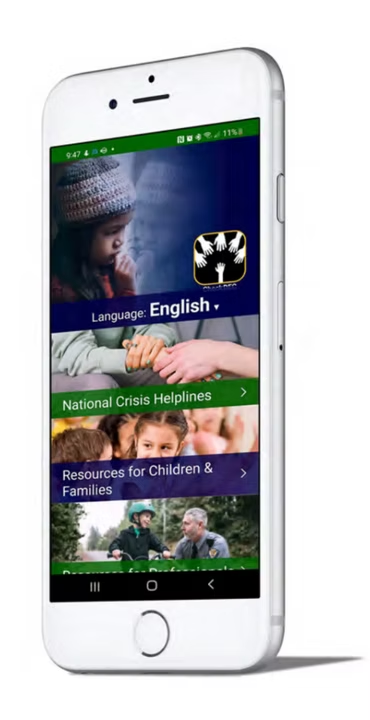


Get the CheckDEC Web App
CheckDEC is a free app from the National Alliance for Drug-Endangered Children that puts local, zip-code–specific substance-use resources, crisis helplines, treatment referrals, videos and real-life stories right in your hand — giving children, families, concerned community members and professionals instant, shareable support when they need it most.
- Direct crisis helpline links and immediate pathways to help.
Resources and downloadable handouts for families and tools for professionals.
Videos, an up-to-date news feed, and peer stories to inform and inspire.
Submit your own story or message of hope; share resources with others.
Free and available now on iOS, Android. Download using the QR code or button, and for more information visit www.checkdec.org.
FAQs
Am I expected to investigate substance misuse beyond my call?
No. You are not expected to conduct additional investigation beyond your role. Your responsibility is to ensure immediate safety, document observable facts, and follow Kansas reporting requirements when appropriate.
What if a child is not visible during the call?
Children may be in another room, staying with a neighbor, or living in the residence, but not present at the time of contact. If you believe a child lives in the environment, document that observation.
Does documenting a child’s presence really make a difference?
Yes. Documentation supports coordinated follow-up and reduces repeat crisis calls. Noting a child’s presence helps ensure that no child is overlooked.
Accurate documentation today can prevent repeated crisis calls tomorrow.
What if I am unsure whether the situation rises to the level of a report?
Reasonable concern is enough. You do not need certainty. You are not diagnosing risk. You are identifying it for further assessment.
How can I connect with a DEC alliance in my county?
KADEC facilitates county-level alliances across Kansas. These partnerships improve cross-system response and reduce duplication. If your county does not yet have one, KADEC can help guide the process.
Have additional questions?
Contact KADEC to connect with training, coordination support, or county-level resources.
Small observations can change long-term outcomes.
You don’t have to solve this alone. Kansas has a coordinated system designed to support children and families. Your role is to notice and respond.
The Kansas Alliance for Drug Endangered Children is a statewide multidisciplinary network formed in 2003 to improve outcomes for children impacted by substance misuse through training, collaboration, and coordinated response.