

You May Be the First Safe Adult a Child Sees.
Look Again is a statewide initiative led by the Kansas Alliance for Drug Endangered Children (KADEC). It supports early recognition, trauma-informed response, and coordinated action for children affected by substance misuse.
Nearly 140,000 Kansas children live in households where substance misuse may impact safety and stability. Many of these children walk into classrooms every day.
You may already be helping more than you realize.
Children experiencing chronic stress may struggle with attention, memory, and emotional regulation.
What Is a Drug Endangered Child?
A drug-endangered child (DEC) is a child who lives in an environment where substance use, misuse, manufacturing, or distribution places their safety, health, or development at risk.
The concern is not the legality of a substance. The concern is whether a child’s supervision, stability, or development is affected.
Early recognition and coordinated response improve long-term academic, emotional, and health outcomes.
Why Early Identification Matters in Schools
What may appear as distraction, defiance, or disengagement can often be a child’s response to stress.
When home environments feel unpredictable or unsafe, those stress responses can surface in the classroom in ways that are easily misunderstood. A small observation, documented and shared at the right time, can open the door to meaningful support. Substance misuse in a household does not define a child’s potential. With early recognition and coordinated care, children can experience stability, resilience, and long-term success.
Children impacted by substance misuse may experience:
- Disrupted sleep
- Chronic absenteeism
- Behavioral dysregulation
- Difficulty concentrating
- Anxiety or withdrawal
- Inconsistent caregiving support
Adverse Childhood Experiences (ACEs) research demonstrates that early trauma can affect long-term academic performance and health outcomes.
Signs You May Notice in a School Setting
The following signs don’t confirm substance misuse. They signal the need for careful observation and appropriate next steps.
You may observe:
- Frequent unexplained absences
- Sudden changes in behavior or mood
- Persistent hunger or hygiene concerns
- Extreme fatigue
- Reluctance to go home
- Disclosure of unsafe environments
Patterns matter more than isolated incidents.
What Look Again Is Asking of Educators
We’re not asking you to investigate, and we’re not asking you to diagnose.
We are asking you to:
- Notice patterns
- Document concerns appropriately
- Follow mandated reporting requirements
- Connect with local support systems
When educators respond early, children are more likely to receive support before situations escalate.
What to Do If You Are Concerned
It can feel uncomfortable to report concerns about a family. Reporting allows trained professionals to assess safety and determine appropriate next steps.
In Kansas, educators are mandated reporters, but remember, reporting only activates assessment. It does not automatically result in removal.
If you suspect a child may be at risk:
- Document observable facts
- Follow your district’s reporting protocol
- Contact the Kansas Protection Report Center: 1-800-922-5330
- Online reporting is available through the Kansas DCF
- Reports can be made 24 hours a day
If a child is in immediate danger, call 911.
Spanish-language reporting assistance and community resources are available.
You don’t need proof; you just need reasonable concern.
Trauma-Informed Response in the Classroom
Children impacted by substance misuse may carry stress responses that show up as:
- Hypervigilance
- Aggression
- Withdrawal
- Emotional dysregulation
Helpful strategies include:
- Predictable routines
- Clear expectations
- Regulated tone of voice
- Calm redirection
- Safe spaces when appropriate
Stability at school can buffer instability elsewhere.
Consistency, predictability, and calm adult responses can serve as protective factors for children experiencing instability at home.
Coordinated School & Community Response Across Kansas
Coordinated response reduces duplication and prevents children from falling through gaps.
KADEC supports Drug Endangered Children alliances in 37 Kansas counties. These alliances connect school districts with law enforcement, child welfare, healthcare providers, behavioral health professionals, and community organizations.
Coordinated response reduces duplication and prevents children from falling through gaps.
KADEC supports Drug Endangered Children alliances in 37 Kansas counties. These alliances connect school districts with law enforcement, child welfare, healthcare providers, behavioral health professionals, and community organizations.
When schools coordinate with community partners:
- Students receive earlier support
- Safety planning becomes clearer
- Communication between agencies strengthens
- Repeat crises are reduced
Your documentation may be the first link in a broader safety net.
If your district isn’t connected to a local DEC alliance, KADEC can help you begin.
Look again. Be the difference.
Quick Access Resources
Kansas Protection Report Center | DCF
Adverse Childhood Experiences Overview | CDC
National Child Traumatic Stress Network | NCTSN
These resources support trauma-informed understanding and appropriate reporting practices.
Downloadable Resources

Know the Signs Printable Tip Card
Download PDF ›
Alcohol Awareness Printable Tip Card
Download PDF ›
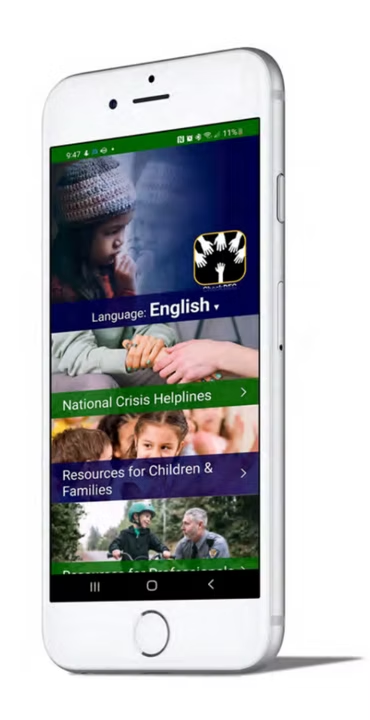


Get the CheckDEC Web App
CheckDEC is a free app from the National Alliance for Drug-Endangered Children that puts local, zip-code–specific substance-use resources, crisis helplines, treatment referrals, videos and real-life stories right in your hand — giving children, families, concerned community members and professionals instant, shareable support when they need it most.
- Direct crisis helpline links and immediate pathways to help.
Resources and downloadable handouts for families and tools for professionals.
Videos, an up-to-date news feed, and peer stories to inform and inspire.
Submit your own story or message of hope; share resources with others.
Free and available now on iOS, Android. Download using the QR code or button, and for more information visit www.checkdec.org.
FAQs
If a student confides in me, what should I do?
Listen calmly. Do not promise confidentiality beyond your role. Document what was shared and follow your district’s mandated reporting protocol.
Am I required to notify administration before making a report?
Follow your district’s policy. In Kansas, mandated reporters cannot transfer their responsibility to someone else.
You’re not required to be certain. You are required to care and act on reasonable concern.
What if I am wrong?
You are not required to be certain. Reasonable suspicion is enough. Reporting allows trained professionals to assess safety and determine next steps.
What if the child asks me not to tell anyone?
You can say: “My job is to help keep you safe.” Reporting is about safety and support, not punishment.
How can my school connect with a DEC alliance?
KADEC supports county-level collaboration among schools, law enforcement, healthcare, and child welfare. These partnerships strengthen coordinated response.
Have additional questions?
Contact KADEC to learn about local alliances, training, and school partnership opportunities.
You may be the steady presence a child remembers
You don’t have to solve this alone. Kansas has a coordinated system designed to support children and families. Your role is to notice and respond.
The Kansas Alliance for Drug Endangered Children is a statewide multidisciplinary network formed in 2003 to improve outcomes for children impacted by substance misuse through training, collaboration, and coordinated response.